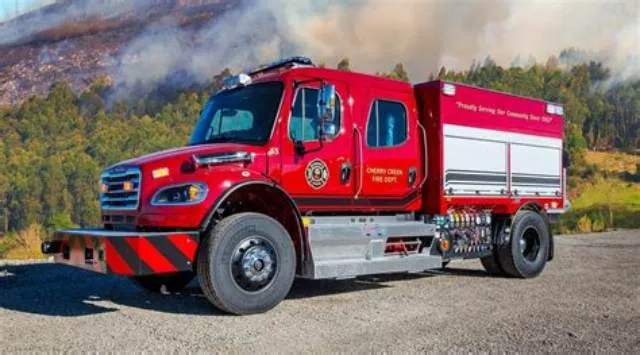
Become a Guardian of the Wild: Wildland Firefighter (Fire Engine Operation) Positions with the USDA Forest Service
Every year, wildfires pose a massive threat to the diverse ecosystems, communities, and natural wonders of the American West. Facing these challenging elements requires a elite group of highly trained, physically robust, and tactically sound emergency responders. The USDA Forest Service is currently seeking dedicated professionals to step into these crucial roles as Wildland Firefighters (Fire Engine Operation).
Operating across dozens of strategic duty stations throughout California and Nevada, these positions offer an unmatched opportunity to merge technical expertise with public service. Working as a Fire Engine Operator involves more than just driving heavy machinery; it is an active leadership role that coordinates fireline construction, leads initial attack teams, and uses specialized water and foam systems to protect public lands and local communities.
About the Agency: The USDA Forest Service
The USDA Forest Service is a world-renowned conservation agency responsible for managing and protecting more than 193 million acres of national forests and grasslands. Established with the core mission of sustaining the health, diversity, and productivity of our country's natural resources, the Forest Service relies on its wildland fire management team to meet modern ecological challenges.
Employees in Pacific Southwest Region (Region 5) manage some of the most dynamic, high-stakes wildland-urban interfaces (WUI) in the world. Joining this team means embracing a culture of safety, mutual reliance, and professional pride. The rewards of working here are as expansive as the majestic landscapes you will protect.
Job Responsibilities
At the full performance grade of GW-07, the Wildland Firefighter (Fire Engine Operation) plays a critical role in both emergency responses and proactive resource management. You will serve as the primary driver and operator of a specialized fire engine module, acting as a direct assistant to the module supervisor.
Key responsibilities include:
- Emergency Fire Suppression: Driving and operating fire engines during responses to wildland fires and all-hazard emergency incidents. This includes executing initial attacks in high-complexity wildland-urban interface settings.
- Tactical Operations: Setting up hose lays, adjusting engine speeds, priming pumps, and selecting appropriate nozzle patterns to maximize water and chemical foam application efficiency.
- Incident Command Duties: In the absence of the Supervisory Fire Engine Operator, you may serve as the initial attack Incident Commander (IC) for emerging wildland fires and local intermix incidents.
- Pre-Suppression & Fuel Analysis: Using basic analytical methods to gather data for fire management planning. This includes preparing and inventorying fuels, and executing prescribed burn plans.
- Resource & Equipment Maintenance: Ensuring the engine and all associated suppression equipment are maintained in a constant state of readiness for immediate dispatch.
Requirements & Qualifications
To be considered for these highly competitive roles, you must meet both general federal employment requirements and specific wildland firefighting standards.
General Requirements
- Citizenship: You must be a United States citizen or national.
- Age Limit: Applicants must generally be under 37 years of age. Exceptions apply for candidates with previous permanent federal firefighter service or eligible veterans requesting a waiver.
- Physical Conditioning: You must take and pass the Work Capacity Test (WCT) at the Arduous level. This requires walking 3 miles with a 45-pound pack in 45 minutes or less.
- Background & Drug Screen: Satisfactory completion of a background investigation and pre-employment/random drug testing is required.
Specialized Experience Comparison
Candidates will be evaluated based on their depth of experience. The table below outlines the core differences in specialized experience requirements between the GW-06 and GW-07 grades:
| Feature / Metric | GW-06 Grade Level | GW-07 Grade Level |
|---|---|---|
| Prior Service Requirement | 1 year of experience equivalent to the GW-05 level | 1 year of experience equivalent to the GW-06 level |
| Core Pump Operations | Starts, primes, and operates pumps; adjusts engine valves and hose layouts | Standardizes equipment procurement; maintains peak operational readiness of modules |
| Prescribed Fire Duties | Assist in igniting, monitoring, holding, and mopping up prescribed burns | Helps develop complex burn plans, fuels inventory, and strategic fuel disposals |
| Leadership & Safety | Directs crew members in pump deployment and localized fire line safety | Implements training programs under the Incident Command System (ICS) |
| Tactical Decision Making | Evaluates local fire behavior and determines rate of fire spread | Assesses initial fire scenarios, determines suppression tactics, and identifies fire causes |
Selective Placement Factors
These positions have strict technical requirements. Your application must include documented proof of the following credentials:
- Primary NWCG Core Requirement: Engine Boss (ENGB)
- Secondary NWCG Core Requirement: Incident Commander Type 5 (ICT5)
- Required Training: Completion of NWCG Course S-211 (Portable Pumps and Water Use)
Note: To prove these qualifications, you must attach your official Incident Qualification and Certification System (IQCS) Master Record. Red cards are not accepted.
Salary & Locality Overview
The base salary for these positions ranges from $57,670 to $81,343 per year.
However, final compensation is adjusted based on your assigned duty station. Because these jobs are located in various areas across California and Nevada, your actual pay rate will include locality pay adjustments set by the Office of Personnel Management (OPM). Additionally, these positions frequently offer opportunities for overtime and hazard pay during active fire seasons, which can significantly increase your overall earnings.
Benefits
In addition to competitive pay, the federal government offers a comprehensive benefits package designed to support your long-term career and personal well-being:
- Special Firefighter Retirement: Covered under the rigorous retirement provisions of 5 USC 8336(c) for CSRS and 5 USC 8412(d) for FERS, allowing for early retirement options.
- Health & Life Insurance: Excellent health, dental, vision, and life insurance plans with substantial employer contributions.
- Paid Leave: Earned annual leave (vacation), sick leave, and 11 paid federal holidays each year.
- Incentives: Recruitment or relocation incentives may be approved by the hiring official for highly qualified applicants.
- Supportive Amenities: Access to government housing, federal childcare assistance, and telework flexibilities may be available at select duty stations.
Application Tips
Applying for federal positions requires careful attention to detail. Follow these expert tips to ensure your application package isn't disqualified:
- The Two-Page Resume Limit is Absolute: Your resume must not exceed exactly two pages. The Forest Service will discard applications with resumes that are three pages or longer.
- Explicitly Document Hours Work: For every job entry on your resume, include your weekly hours worked (e.g., "40 hours/week"). If this is missing, HR may not credit your experience.
- Do Not Send Red Cards: Red cards are not accepted as proof of credentials. You must upload your official IQCS Master Record to satisfy the selective placement factors.
- Confirm USA Staffing Transfers: After applying through USAJobs, confirm that all your uploaded documents have successfully transferred to the USA Staffing system.
Q2: What happens if my IQCS qualifications are not currently active?
While you must have successfully completed the qualifications in the past, active currency is not required for selection. If selected, you must show documented proof of past qualifications and regain currency within one year of hire.
Q3: What is the Work Capacity Test (WCT)?
Also known as the 'pack test,' this is a physical test required for wildland firefighters. For this job, you must pass at the arduous level by carrying a 45-pound pack for three miles in under 45 minutes.
Q4: Are these jobs permanent or seasonal?
These are permanent federal positions. However, they may feature varying tours of duty, including full-time schedules or guaranteed minimums of 13 pay periods of full-time work per year.
Working as a Wildland Firefighter (Fire Engine Operator) for the USDA Forest Service is more than just a job—it's a commitment to protecting our natural resources and communities. This career path offers hands-on leadership, rigorous physical challenges, and the reward of preserving our nation's wildlands.
Make sure your resume is formatted correctly, gather your IQCS documents, and submit your application before the September 22, 2026 deadline to start your journey.
Why This Wildland Firefighter (Fire Engine Operation) Job Matters
Defend California’s magnificent landscapes and protect communities at risk—step up as a Wildland Firefighter (Fire Engine Operator) with the USDA Forest Service.
Wildland Firefighter (Fire Engine Operation) Job Overview
The USDA Forest Service is hiring multiple Wildland Firefighters specializing in Fire Engine Operation (GW-06/07) across dozens of scenic locations in California and Nevada. In this high-impact, physically demanding role, you will drive and operate heavy wildland fire engines, lead specialized crews, and perform critical tactical suppressions. If you possess the required technical NWCG fire certifications and are ready to tackle arduous environments, this career pathway offers outstanding federal benefits and incredible growth potential.
Requirements for Wildland Firefighter (Fire Engine Operation)
- Must be a citizen or national of the United States.
- Must be at least 18 years of age.
- Males born after December 31, 1959 must be registered for Selective Service (or be exempt).
- Must successfully complete and pass a background investigation and fingerprint check.
- Subject to pre-employment and random federal drug testing (Drug Testing Designated Position).
- Must pass the Work Capacity Test (WCT / Pack Test) at the Arduous level.
- Must be under the age of 37 at appointment (with exceptions for veterans' preference or previous permanent federal firefighter service).
- Must complete a 1-year federal probationary period.
- Possession of a valid state driver's license or Commercial Driver's License (CDL) may be required depending on location.
- Willingness to live and work in highly remote, unpredictable, and volatile outdoor environments.
Preferred Qualifications for Wildland Firefighter (Fire Engine Operation)
- Active primary NWCG Core Requirement of Engine Boss (ENGB).
- Active secondary NWCG Core Requirement of Incident Commander Type 5 (ICT5).
- Successful completion of NWCG Course S-211 (Portable Pumps and Water Use).
- Current Interagency Fire Program Management (IFPM) or Forest Service - Fire Program Management (FS-FPM) credentials.
- A fully documented and signed Agency Certified task book or IQCS Master Record.
Federal Benefits & Perks
- ✓Competitive salary ranging from $57,670 to $81,343 per year (plus applicable locality adjustments).
- ✓Comprehensive federal health benefits, dental, vision, and life insurance plans.
- ✓Special Rigorous Firefighter Retirement Coverage under CSRS/FERS (5 USC 8336(c) and 8412(d)).
- ✓Paid annual leave, sick leave, and 11 paid federal holidays.
- ✓Potential relocation or recruitment incentives for highly qualified selected candidates.
- ✓Government housing, federal daycare facilities, and telework flexibilities may be available at select duty stations.
- ✓Defined career development paths with non-competitive promotion potential to the GW-07 grade.
💡 How to Apply Wildland Firefighter (Fire Engine Operation) Job & Insider Tips
Application Steps for Wildland Firefighter (Fire Engine Operation) Job
- Review the full job announcement carefully, noting all requirements and the critical two-page limit on resumes.
- Ensure your resume specifically details your work history, including exact start/end dates, hours worked per week, and specialized wildland firefighting experience.
- Acquire your official Incident Qualification and Certification System (IQCS) Master Record (Red Cards are not accepted as proof).
- Navigate to the application page via USAJobs and click 'Apply Online'.
- Complete the Assessment Questionnaire and upload your resume, IQCS Master Record, and any other supporting documents (such as SF-50s or CTAP/ICTAP documentation if applicable).
- Submit your complete application package before the closing deadline on September 22, 2026, at 11:59 PM Eastern Time.
💡 General Tips
- Strict Resume Limit: Your resume must not exceed exactly two pages. Resumes that exceed this limit are automatically disqualified without review.
- Do Not Submit Red Cards: To satisfy the Selective Placement Factors, you must attach an official IQCS Master Record or equivalent certified training document. Red Cards will not be accepted.
- Quantify Your Experience: Clearly state the number of hours worked per week for each firefighting position listed on your resume to receive full credit.
- Locality Adjustments: Be aware that the stated salary is the base 'Rest of U.S.' range; final compensation will vary depending on your selected duty location's locality pay.
- Prepare for the Physical Test: Start conditioning early. Passing the Arduous Work Capacity Test (carrying a 45-pound pack for 3 miles in under 45 minutes) is a non-negotiable condition of employment.
Frequently Asked Questions
What is the maximum age limit for this wildland firefighting position?
Applicants must generally be under the age of 37. However, you may qualify if you are older than 37 and have previous permanent federal service covered under primary firefighter retirement, or if you are a veteran's preference eligible applicant requesting an age waiver.
Can I use my red card to prove my NWCG qualifications?
No. The agency strictly requires your Incident Qualification and Certification System (IQCS) Master Record or an equivalent certified training document. Red cards are not accepted as valid proof.
What is the Work Capacity Test (WCT) requirement?
Because this position involves active wildland firefighting duties, you must pass the Work Capacity Test at the 'Arduous' level. This requires walking three miles while carrying a 45-pound vest/pack in 45 minutes or less.
Does this job require extensive travel?
Yes. Due to the nature of wildland fire suppression and emergency hazard response, you must be willing to travel frequently and work irregular, protracted hours in highly remote and unpredictable environments.
Q1: Can I apply if I am over 37 years old?
Yes, but only under specific circumstances. You must either have previous permanent federal service in a primary firefighter or law enforcement position, or be an eligible veteran requesting an age limit waiver.