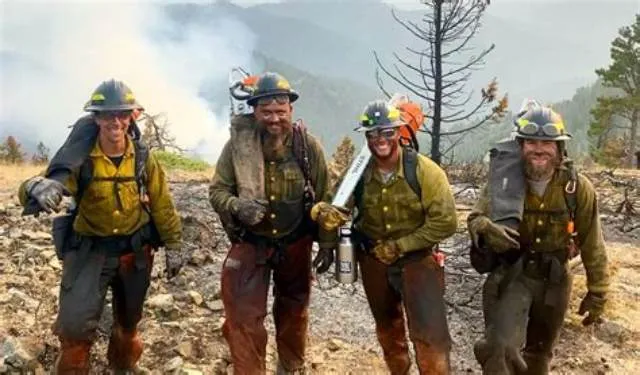
Guarding the Smokies: Becoming a Wildland Firefighter in Gatlinburg, Tennessee
The Great Smoky Mountains National Park stands as a biological wonderland and one of America's most visited natural sanctuaries. Preserving this vast landscape from the destructive potential of uncontrolled wildland fires is a monumental task. The Department of the Interior’s U.S. Wildland Fire Service (USWFS) is seeking dedicated, physically resilient individuals to step into the role of Wildland Firefighter (Wildland Fire Module) in Gatlinburg, Tennessee. Operating at the GW-06 grade level, this career opportunity allows you to live, work, and lead on the front lines of forest preservation.
This position is not just a job; it is a calling for those who thrive in the outdoors, possess strong leadership skills, and are committed to public safety and ecological restoration. This comprehensive guide outlines everything you need to know about this unique opportunity, from the agency's mission to specific physical requirements and direct-hire application tips.
Job Responsibilities
As a Wildland Firefighter within a specialized Wildland Fire Module, your days will be physically demanding, intellectually challenging, and deeply rewarding. You will serve as an experienced crew member and situational leader, directing small teams in high-stakes environments.
Key duties include:
- Fire Suppression & Tactical Operations: Directly attacking, controlling, and mopping up wildfires. This involves constructing firelines, managing burnout operations, falling hazardous trees (snags), clearing brush, and suppressing spot fires.
- Operational Readiness: Ensuring your assigned crew members and tactical equipment are in a state of continuous preparedness for initial attacks or emergency deployments.
- Fuels Management & Prescribed Burns: Leading less-complex fuels management projects and participating in highly complex operations. This includes executing prescribed fires, conducting mechanical and biological fuel treatments, and building vegetation debris piles.
- Ecological Monitoring: Gathering critical field data for monitoring programs to assess the impact of fire on local flora and soil systems.
Requirements and Qualifications
This position is physically arduous and requires a specific blend of prior experience, physical capability, and technical certifications.
Specialized Experience
To qualify for the GW-06 grade level, you must possess at least one full year of specialized experience equivalent to the GW-05 level in federal service. This experience must be clearly detailed in your resume and include:
- Leading crews in prescribed burning and active wildfire suppression.
- Performing hazardous fuels reduction and ecological fire monitoring.
- Operating specialized tools and managing initial tactical attacks.
Note: There is no option to substitute education for experience at this grade level.
IFPM Key Position Requirements
This role is classified as a Senior Firefighter under the Interagency Fire Program Management (IFPM) Standard. Before placement, you must possess the following National Wildfire Coordinating Group (NWCG) certifications:
- Firefighter Type 1 (FFT1)
- S-290 (Intermediate Wildland Fire Behavior Training)
- One of the following: Fire Effects Monitor (FEMO), Helicopter Crewmember (HECM), or Helicopter Long-line/Remote Hook Specialist (HELR).
Physical and Age Demands
- Work Capacity Test (WCT): You must pass the arduous-level physical fitness test (carrying a 45-pound pack over 3 miles in under 45 minutes).
- Maximum Entry Age (MEA): Due to the rigorous physical demands and enhanced retirement benefits, applicants must be appointed before their 37th birthday. Exceptions apply for preference-eligible veterans and those with qualifying prior covered federal service.
Salary Overview and Comparison
The salary for this position ranges from $57,670 to $74,970 per year, paid on a career-seasonal schedule. It is important to understand how this permanent seasonal appointment compares to standard year-round federal positions.
| Job Attribute | Permanent Seasonal Appointment (This Role) | Standard Permanent Federal Position |
|---|---|---|
| Active Pay Status | Approximately 9 months per calendar year | 12 months per calendar year |
| Off-Season Status | Placed in non-pay status when work/funds are unavailable | Remains in pay status year-round |
| Benefits Eligibility | Full career benefits (health, retirement, TSP) year-round | Full career benefits year-round |
| Career Progression | Counts fully toward retirement and step increases | Counts fully toward retirement and step increases |
Benefits
Even though this is a seasonal position, it is a permanent career appointment. That means you are eligible for the same premium benefit suite as year-round federal employees:
- Special Enhanced Retirement: Covered under the federal firefighter retirement system (5 U.S.C. 8336(c)), which offers an enhanced annuity and a mandatory retirement age of 57.
- Health and Wellness: Access to the Federal Employees Health Benefits (FEHB) program, dental, vision, and flexible spending accounts.
- Thrift Savings Plan (TSP): Federal 401(k) equivalent with up to 5% agency matching contributions.
- Paid Time Off: Accrual of annual leave, sick leave, and paid federal holidays while in active pay status.
- Travel Accommodations: Government travel card issuance, paid travel expenses, and per diem while deployed away from Gatlinburg.
Application Tips
Securing a federal position requires strict adherence to OPM guidelines. Follow these strategies to ensure your application survives the HR screening process:
- Respect the Resume Page Limit: Your resume must not exceed two single-sided pages. Use a legible, minimum 10-point font and 0.5-inch margins. Any content on page three or beyond will be ignored.
- Detail Your Work Hours: You must explicitly list your hours worked per week (e.g., "40 hours/week" or "20 hours/week") for every position. Failure to do so may result in your experience not being credited.
- Provide Proof of Age: Upload government-issued identification (driver's license, birth certificate, or SF-50) to verify you are under the 37-year-old maximum entry age limit.
- Submit Your IQCS Record: Your Incident Qualification and Certification System (IQCS) Master Record must be attached to prove you hold active FFT1, S-290, and FEMO/HECM/HELR credentials.
- Tailor Your Resume to the Questionnaire: Use the online assessment questionnaire preview to identify the primary competencies. Ensure your resume contains clear examples of how you have met those competencies.
Serving as a Wildland Firefighter (Wildland Fire Module) in Gatlinburg is more than a career—it is an adventure that leaves a lasting positive impact on the environment. If you have the required NWCG credentials, the physical stamina to conquer the pack test, and a desire to lead a dedicated team in the Great Smoky Mountains, take the next step in your career. Ensure your federal resume is meticulously formatted and submit your application package before the September 9, 2026 deadline.
Why This Wildland Firefighter (Wildland Fire Module) Job Matters
Protect one of America's most treasured natural landscapes as a Wildland Firefighter in the heart of the Great Smoky Mountains.
Wildland Firefighter (Wildland Fire Module) Job Overview
The Department of the Interior's U.S. Wildland Fire Service is seeking a dedicated, highly motivated Wildland Firefighter (Wildland Fire Module) for a Permanent Seasonal position based in Gatlinburg, Tennessee. Operating at the GW-06 level under Direct-Hire Authority, this critical position involves leading and executing crucial wildland fire suppression, fuel management, ecological monitoring, and prescribed burn operations within the rugged terrain of the Great Smoky Mountains National Park.
Requirements for Wildland Firefighter (Wildland Fire Module)
- Must be a citizen or national of the United States.
- Must be at least 18 years of age and under the Maximum Entry Age (MEA) of 37 at the time of appointment (exceptions apply for preference-eligible veterans and those with prior covered federal service).
- Must pass a pre-employment medical examination and be subject to random drug testing.
- Ability to successfully complete the arduous-level Work Capacity Test (WCT), also known as the pack test.
- Must possess and maintain a valid state driver's license.
- Must wear the official U.S. Wildland Fire Service uniform.
- Subject to a background suitability investigation.
- Must register with the Selective Service (if male assigned at birth after December 31, 1959).
- Willingness to travel frequently (up to 20 nights per month), especially during active fire season.
- Must obtain and maintain a government travel charge card.
- No prior convictions for misdemeanor or felony crimes of domestic violence unless expunged, pardoned, or set aside.
Preferred Qualifications for Wildland Firefighter (Wildland Fire Module)
- Prior experience working in rugged backcountry conditions for extended periods.
- Demonstrated tactical leadership capabilities on complex prescribed fire or wildfire suppression assignments.
- Advanced understanding of fire behavior, local fuels, and weather patterns in eastern deciduous forest ecosystems.
Federal Benefits & Perks
- ✓Special enhanced federal retirement annuity provisions for federal firefighters (5 U.S.C. 8336(c) and 5 U.S.C. 8412(d)) with a mandatory retirement age of 57.
- ✓Permanent seasonal status offering career-building stability with structured off-season breaks (approximately 9 months active status per year).
- ✓Comprehensive health, dental, and vision insurance options.
- ✓Life insurance plans and eligibility for the Thrift Savings Plan (TSP) with government matching.
- ✓Paid annual leave, sick leave, and federal holidays while in active pay status.
- ✓Paid travel expenses and per diem during active wildfire deployments.
💡 How to Apply Wildland Firefighter (Wildland Fire Module) Job & Insider Tips
Application Steps for Wildland Firefighter (Wildland Fire Module) Job
- Draft a detailed federal resume limited strictly to two single-sided pages, utilizing at least a 10-point font and 0.5-inch margins.
- Gather all mandatory supporting documents, including proof of age (e.g., driver's license), IQCS Master Record confirming NWCG qualifications, and any relevant SF-50s or DD-214 forms.
- Log into or create an account on USAJOBS.gov.
- Navigate to the vacancy announcement and click the 'Apply' button.
- Complete the online assessment questionnaire and upload all required documents.
- Acknowledge the final submission checklist and submit the application package before the closing deadline on September 9, 2026, at 11:59 PM Eastern Time.
💡 General Tips
- Adhere strictly to the two-page resume limit. Any pages beyond the second page will not be reviewed, which can lead to automatic disqualification.
- Explicitly detail your weekly hours worked (e.g., '40 hours/week') and exact start and end dates (MM/YY) for all previous employments to receive proper experience credit.
- Ensure your Incident Qualification and Certification System (IQCS) Master Record is updated and uploaded. Missing proof of NWCG credentials like FFT1, S-290, and FEMO/HECM/HELR will result in a 'not qualified' rating.
- Verify that your date of birth is clearly visible on your submitted identification documents to prove compliance with the mandatory entry age limit.
- Use the questionnaire preview link to review the assessment questions in advance and format your resume to explicitly back up your answers.
Frequently Asked Questions
What is the maximum entry age for this position?
Because this position is covered under special primary firefighter retirement laws, applicants must not have reached their 37th birthday at the time of appointment. Exceptions are made for preference-eligible veterans and individuals with sufficient prior covered federal service.
Is this a year-round position?
No, this is a Permanent Seasonal (Career-Seasonal) appointment. You will be in an active pay status for approximately nine months out of the year and placed in a non-pay status during the off-season when work or funding is unavailable.
Can I substitute education for experience to qualify?
No. At the GW-06 grade level, there is no option to substitute education for the required one year of specialized experience.
Are travel expenses covered for deployments?
Yes. Firefighters are issued a government travel charge card, and all official travel expenses, lodging, and per diem during field assignments are covered by the agency.
Does veterans' preference apply to this vacancy?
No. This position is being filled under OPM's Direct-Hire Authority (DHA). Traditional veterans' preference ratings and ranking procedures are not utilized, though qualified veterans still receive valuable age waiver benefits.
Where is the primary duty station for this job?
The primary duty station is located in Gatlinburg, Tennessee, within the Great Smoky Mountains National Park.
Is there government housing available?
Government housing is not explicitly guaranteed under this announcement. Applicants should be prepared to secure local housing in the Gatlinburg commuting area.
Are there travel requirements?
Yes. During the peak wildland fire season, you may be required to travel up to 20 nights per month, living in backcountry camps under primitive conditions.
What is the Direct-Hire Authority?
This position is filled under a Direct-Hire Authority. Traditional veteran ratings, rankings, and preferences do not apply; all applicants who meet the minimum qualifications and physical standards will be referred directly to the hiring manager. ---
Job from Office Of The Secretary Of The Interior
The U.S. Wildland Fire Service (USWFS), a key agency within the Department of the Interior, is charged with managing, suppressing, and researching wildland fires across more than 500 million acres of public and tribal lands. Working closely with partners such as the USDA Forest Service, state foresters, tribal nations, and local volunteer departments, the USWFS promotes fire-resilient landscapes and protects neighboring communities.
By joining the USWFS, you become part of an interagency framework that values diversity, professional development, and safety above all else. The Gatlinburg, Tennessee location places you in the heart of the southern Appalachian Mountains, a complex ecosystem that requires sophisticated fire management techniques, from hazard fuel reduction to precise prescribed burns.